Consciously I want to evolve.
My ego resists and I forget it all.
So I blog, re-read, remember.
I've wandered paths & influences, but now I have no doctrine but the side-effects of my experiences. I've a a spirit twin/mate and we make a larger self; I'm 4th of 4 (he is 3rd), which make a larger self; there are 12 identities I call The Consortium who combine in mine. Chakras (and their mates) are entities. We are STARS and spirituality is cosmology.

Recent Posts & Archives

  • 2012 (2)
  • 2011 (44)
  • 2010 (117)
  • 2009 (99)
  • 2008 (61)
  • 2007 (14)

Categories

The Blood

This has been a weird weekend.

First of all, I’ve been trying to do a meditation for a couple days now. It does not matter how much energy and alertness I have when I begin; a short time into it (and ‘getting around to it’ takes forever to begin with) I just pass out abruptly. This is the “your worst enemy” meditation it was suggested by someone internal, probably Inner Guide, that I do.

So far all I have accomplished is completely screwing up my work life, which was supposed to be filled with work this weekend, instead of filled with abruptly going to sleep, when I’d already had enough or too much sleep, resulting in being nearly solomnic. Now it is nearly 2am on a Monday and I will write this and then be working from now until I’m off Monday afternoon, or later — since I have something that was due Friday night. I could just kick myself. If I knew it was going to be that difficult… I would have done all work BEFORE attempting it.

Now I know. I will need to do the meditation perched on the edge of my couch, with the light on half-dim, so I am not comfortable enough to pass out and if I do, hitting the floor will surely awaken me. This is not as difficult as ‘The Knight of Wands’ tarot that took six months to get through, nor as difficult as the ‘Fear of Psi’ meditations that required broad daylight, sunlight in a window, standing up, eyes open, back to a wall, radio in the background, projecting the archetype against the other wall. (I suspect people who don’t do these meditations have no idea how… visceral they can be.)  This is merely obnoxious. I will get it done.

My work schedule is the secondary problem. A hideous deadline looms both tomorrow early, and Friday for a bunch of things, that I am the only one free to do and already trained on, so it falls to me. I don’t know how much time — how much time without serious sleep deprivation — I will have this week. But I will get to it.

*

Today fairly early I happened to see online, and now I can’t remember how, a photo of red blood cells. My whole body reacted with adoration. Like the color and shape both ‘fed’ me. Like it was the art of the most beautiful woman or faery creature. I just breathed it in for awhile.

It reminded me of a remote viewing session I once did on red blood cells. It had that powerful sense of “divine technology” that I’ve since learned is how I interpret microscopic scopes of biology/botany/chemistry/etc.  I went so on and on about how I loved that target that my tasker for it eventually sent me a framed photograph of the feedback. It sits on the top of my bookcase headboard.

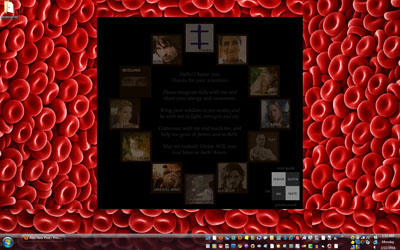
desktopI had such a desire to see it, more and more, to have it in my life, that I modified my desktop background. Currently my 1456×856 screen has an all-black background with a picture of the 12 Aeons (renditions of them anyway) in a circle around it and a small square showing the IG/Four in the bottom corner. I revised this so that all around that circle, and above and below it, are the red blood cells. Then I just kept switching to the desktop and staring at it in fascination.

Here’s a pic. Stupid, isn’t it. This is how completely nuts I went. And I should have been doing other, more constructive things.

But it wasn’t enough. Not enough! I must have more, more!  Red blood cells are like my pxrn for the day or something. I went googling. The net equivalent to wandering the strip clubs. Medical microscopic galleries, oh my!  And I ogled all kinds of red blood cells, and white blood cells, and platelets. And I found tiny movies of them too, the 3D cinema stuff is big in the medical world. And I read all about the 5 major kinds (and there are sub-kinds) of white blood cells. And how AMAZING it all is. Absolutely amazing.

How alive is this life inside us? If giant aliens looked down and saw cars the size of microbes, would they assume our highways were blood vessels? Would they assume we had no independent intelligence? That we were all some variant on amoeba stimulus-response?

When white blood cells need to get to something outside the blood vessel? Fairly recent discovery. They simply sprout sucker-legs and walk. I am not making this up. They slide through the capillary or whatever they’re in and stomp out and kick something’s ass. When a big blood parasite, looking like a half-strand of spaghetti, is roving through? The white blood cell — a single one — communicates with tons of red blood cells, commanding them like an army, in a process that can take hours. They gather in massive hordes against the body of the thing and entrap it so it can’t move. Then the white cell wades in to the center of it all and sprays it with something that causes the skin of the pathogen to fester and break open and then as it bleeds to death, in its own way, it’s dead enough that this and other white blood cells can clean it up by absorbing it. I used to think that white cells were in blood and so when invader stuff came through, it would “eventually run into” a white blood cell that would fight it. No. The white blood cell basically perceives it in the distance, with no recorded way of knowing of it as far as we’re concerned, and hunts it down to kill it. White blood cells also in their varying forms have specialized duties, like soldiers; some are officers, most are footsoldiers, a few are engineers, and a rare subclass are snipers. When even platelets are floating through the bloodstream they are happy little disks, until ‘activated’, at which point they look like little multi-point thorns.

And this is just one teeny tiny particle of one teeny tiny part of biology, and yet even the details of the four major components of blood (plasma, white cells, red cells, platelets) are enormously complex and obviously more complex than even we know yet. Most of our photos are electron — something basically killed and stained — though scopes get better. Darkfield scopes like Rife invented (true darkfields, not the ‘adapter lenses’ pretending to be that) see things while alive, while changing, and gave rise to the field of pleomorphism, an ‘alternative’ field of medical study I find a fascinating branch. But still the point is, that is astounding. HOW MUCH intelligence does the body at that level have?

Are we complete morons that we are assigning nothing more than biochemistry to everything going on? Couldn’t a larger intelligence find something similar with which to attribute everything in human society as well? Does a blood clot look like a highway multi-car accident? Or a fishing net full of sea life?  Does a bacteria ‘dealt with by the immune system’ look like an episode of COPS? What is it that makes us assume, as if we are LEGION, and nothing else has intelligence but us, that the body is ‘merely’ biochemical?

I have access to some of the best university textbooks around on things like this. I like the pretty pictures. But I swear, the mode of teaching is absolutely mind numbing. I could not possibly remember all that crap and why would I want to. It seems to me that nobody teaching this stuff finds it miraculous and amazing and then starts at the beginning and teaches it like that, sharing that wonder. Come on, this stuff is incredible. Instead it’s this huge disconnected set of overly complicated terminology and drawings of pieces of cells or whatever that have no translation, no meaning inside us, it’s just a bunch of complicated dead words. It’s amazing that the people who most love any subject, ever get through a degree about it, let alone have any wonder left on the other side.

I stared at the desktop red blood cells again for awhile. Then I looked at a neat picture (here) and it occurred to me: these are not just little disks and blobs. They are not just the blob eating the string or fuzzball. These are the freaking tigers and zebras of the inner world! There’s jackals and snakes and birds of prey and more. Inside us, it’s not just that they are cute little geometric shapes. Oooh, a red one, how pretty!  No, that’s just our super limited perspective. Up close, they are CREATURES. They are not just some chemical component of life, they are ALIVE on their own merits. They have tribalism, they have cultures gone wrong, they have cells turned to the dark side, and they have an entire universe in our body, in even any tiny part of our body, that we barely have even an inkling about.

I just couldn’t get over the idea that I was looking at creatures, things I only saw as ‘blob and disk’ but that up close they probably perceived themselves differently. To them maybe every one is as unique as the faces/bodies in our world. How does a white blood cell know a red cell or even a sickle-red cell, from a pathogen? Obviously there is ‘some’ kind of recognition. Biochemical. Riiiiight. Do you think giant aliens look at the frequencies of light, sound, and heat, a teeny tiny spectrum in their larger world, and think that everything humans do is based on this?  Because IT IS. Explain what is so unique about human life and interaction in reality vs. that of the components of our blood that makes us in any way superior. I don’t see it anymore.

I have no idea what came over me. I’m just suddenly obsessed with the blood. Especially red cells visually, but really the whole thing conceptually.

And if I ever get any time NOT working this week, and get done with the ‘worst enemy’ meditation — oh my god. You don’t think that suggestion could be because something biological is going on that needs that energy worked out do you? Gahhh! — then I will get to some kind of meditation on the blood as well.

The body is a miracle. It’s like oranges and water; two things I cannot observe up close without feeling like there is clearly some divine intelligence involved.

Jung, Archetypes, The Red Book

I’ve been reading “The Red Book,” Liber Novus, which is actually a combination of writings but mostly a big work, previously unpublished, by Carl Jung. It has with it a lot of writing by other people as editorial notes, translator’s notes, and an introduction long enough to be a short book of its own. I’ll be quoting from it in this post, and probably another couple in the future.

The first part of the book is the original writing from Jung, which is calligraphic, and in German mostly I believe, and is “Illustrated” with many pictures, mandalas and symbols he chose to put in it. Beautiful.

Rhea White might have called it his own personal Exceptional Human Experience Autobiography. If Jung had lived today, he’d have a blog like Psiche, but given he was far more brilliant than I’ll ever be, probably something extra.

I find it fascinating, prior to even diving into his own intentional archetype work — “active imagination,” he called the process of allowing the mind to present images, beings or landscapes, and interacting with this — to read about how his involvement in this came about, and a kind of overview of his thinking on these things, and some of his comments about it.

It’s also interesting to see that a century later, here I am sitting at a laptop computer using the internet, something not even conceptualized in his time, although it may be the closest thing to the realization of the “collective unconscious” since that funny little thing we call “reality” — and many of the same realizations, and issues, have come, or gone, and stayed obnoxiously present, in my life and experience as similar things which he was going through as well. Honestly, the correspondence between my own weird internal life and his is rather validating in some respects.

I have read a little bit (online) from Jungian analysts. Though I am a fan of Jung himself, I am not on the same page with the whole J.A. sector; I don’t understand it. I don’t mean that I can’t wrap my brain around the sometimes abstract or complex nature of it. I mean that when I experience this archetypes work over the years, and then I read some essay by someone in that genre, I am overwhelmed with the feeling that whatever they are talking about, it is not borne of these experiences, it is not the voice of insight from experience talking, but rather, armchair intellectualism gone amuck.

Usually I see in such people a wish to be able to tell others what their experiences mean; a side-effect of psychoanalysis as a goal I assume. Most psychoanalysts in my view would be better served by more living and less thinking, and figuring out what their own experiences mean first. Jung actually attempted this very thing, which is what makes him a brilliant forerunner in the whole genre, and not one of the endless armchair orators. I’m reminded of a story I once read where Shakespeare comes back into a college classroom as a student studying, of all things, Shakespeare, but has no idea what on earth the teacher is on about. The pontificating ‘advanced analysis’ of what his work ‘really meant’ is, rather like religion, much more about the endless fractal of self-pleasure an intellectual can engage in and not about the spirit of the thing at all.

Jung had what I consider certain pre-conceived notions about psychology and divinity, and so a great deal of his experience was forcibly stuffed into these models especially early on. Yet even he quickly and repeatedly outgrew some of those models and was forced to reconsider “what it all means.” He had a great deal of self-education in areas like mythology, as one of several examples, which showed up in his imagery as well. Or perhaps it shows up in all our imagery; he was just educated enough to recognize the roots of commonality. In some respects, his role as a psychoanalyst, and intellectual, and scientist, forced certain boundaries upon him that hapless proletarians like my friends and I are blessedly unbothered with.

In other respects, it is his role in those areas that forced him to attempt to approach this with some degree of organization, and documentation, and with the hope of better understanding. I imagine that was exceptional in his day. I don’t think it so much is today. Or perhaps it is ‘statistically’, but as the internet has made the world so small, we see enough of it, and read enough of it in school, to consider this normal. If we have this today, my friends and I, it is maybe in part because this seems intuitively obvious to one who has even half an intellectual bent; we have all heard of the combination of “science and magic” and have the benefit of the personal explorations in such from people who have gone before, including Jung himself. Plus, it is a way of externalizing the internal, of being able to objectify it later and not simply forget it or be lost in the inner-abyss, and perhaps in small part a way of constantly trying to reassure ourselves that we are not crazy.

Some of the writings I’m most influenced by that I feel affect these experiences, such as Jane Roberts and Aleister Crowley and William James and Edwin Steinbrecher, have surely added at least a century worth of insight to the fortunate descendents like me. I did not have to reinvent the wheel. Better still, the definition of that wheel was vastly more open to individual experimentation and interpretation by the time I arrived at it. Though I imagine in another century from now, humans might be even more understanding than we are today. We can only hope.

Taking his cue from William James, among others, Jung contrasted directed thinking and fantasy thinking. The former was verbal and logical, while the latter was passive, associative, and imagistic. The former was exemplified by science and the latter by mythology.

Accepting and interacting with the irrational of the imaginal realm, and then documenting it, and then evaluating it — literally while within it, symbolically while outside it — seems rather normal now, though it was a novel and utterly brilliant step forward in Jung’s day. Getting to the point where one maintains a firm stance in ‘the real world’ while simultaneously learning to take seriously what happens internally, and not just write it off as ‘just imagination’, seems part of the growth that everyone doing this work runs into. That the important part is the experience/interaction, the sharing of energy, he understood.

Everyone, he claimed, had this ability to hold dialogues with him- or herself. Active imagination would thus be one form of inner dialogue, a type of dramatized thinking. It was critical to disidentify from the thoughts that arose, and to overcome the assumption that one had produced them oneself. What was most essential was not interpreting or understanding the fantasies, but experiencing them. This represented a shift from his emphasis on creative formulation and understanding in his paper on the transcendent function. He argued that one should treat the fantasies completely literally while one was engaged in them, but symbolically when one interpreted them.

Some of his ‘cosmology’ that shaped his experiences — or their understanding — I find curious, and often there is a sort of “genre in common” with some of my own experiences. This is something Jung studied and I do not — the relationship of all people in this realm, of the collective unconscious; which also relates to the relationship between man and nation, for example. This has parallels in Jane Roberts’s work, though from a different perspective. I find such topics huge and fascinating but frankly beyond my interest and probably beyond my intellect. The ‘symbols in common’ in places are interesting though.

In Jung’s fantasies, a new God had been born in his soul, the God who is the son of the frogs, Abraxas. Jung understood this symbolically.

I had an Inner Guide who was my brilliant teacher and yet also, while a man in form with me, something akin to a giant frog in his true nature. It is difficult for me not to see the ‘inner guide’ as being easily cast in a ‘god/soul’-role if someone had a different mental model than myself–especially one like Jung’s. And what are the odds of a man/frog/god showing up in two people so separated by time, space and much philosophy? In his drawings I see on occasion other little elements.  I guess we all have our own private Tarot.

My own introduction from medical-model skeptic to something more real on the inside was via a decade of study of hypnosis; trance states fascinate me. This eventually led to spontaneous experiences across a spectrum, probably related to Kundalini, and then a many years study related to psi, and the ‘archetype’ stuff folded in before, during and after that primary focus, but dominantly was allowed in my psychology at all, because of the work with trance and psi. I called my blog Psiche to combine both the Psyche of psychology and the Psi of connectedness with the universe and others. Apparently Jung had a little bit similar progression. And I often feel like the lone ranger with this stuff, though I know I am not. Similarly, Jung was not alone in the world with this study and experience-set, though his comments indicate he often felt so.

As indicated, Jung had had extensive experience studying mediums in trance states, during which they were encouraged to produce waking fantasies and visual hallucinations, and had conducted experiments with automatic writing. Practices of visualization had also been used in various religious traditions. … the fifth of the spiritual exercises of St. Ignatius of Loyola … Swedenborg … psychoanalyst Herbert Silberer … Ludwig Staudenmaier, a professor of experimental chemistry; published a work entitled Magic as an Experimental Science. Staudenmaier had embarked on self experimentations in 1901, commencing with automatic writing. A series of characters appeared, and he found that he no longer needed to write to conduct dialogues with them. He also induced acoustic and visual hallucinations. The aim of his enterprise was to use his self-experimentation to provide a scientific explanation of magic. He argued that the key to understanding magic lay in the concepts of hallucinations and the “under consciousness”, and gave particular importance to the role of personifications. Thus we see that Jung’s procedure closely resembled a number of historical and contemporary practices with which he was familiar.

On occasion, some of the archetypal exploration leads to serious (though temporary) destabilization and re-stabilization in a new center, because the entire concept of “I” — the identity — is so demolished; because the concept of the “Self” as a vastly larger and multitudinous entity arises, and figuring out what is I, vs. Other, vs. Both, and how does I exist through that other and vice-versa, is an entire study and experience and issue, wholly apart from [though inextricably entwined with] whatever the topics one might be working on directly in meditation. Much of Jung’s experience also included this.

In 1921, the “self” emerged as a psychological concept. Jung defined it as follows: Inasmuch as the I is only the center of my field of consciousness, it is not identical with the totality of my psyche, being merely a complex among other complexes. Hence I discriminate between the I and the self, since the I is only the subject of my consciousness, while the self is the subject of my totality: hence it also includes the unconscious psyche. In this sense the self would be an (ideal) greatness which embraces and includes the I.

also:

Yet even these profound allowances for archaic and original speech across abysses of meaning fail to approximate the destabilizing experience, in and through language, to which Jung testifies.

That exploration of this … internal and supernal cosmology, for lack of a better way of putting it, becomes the whole work — with everything else being subsumed as a part of that really, and it being a seemingly cyclical process — is something he apparently accepted as well.

The realization was that the self is the goal of individuation and that the process of individuation was not linear, but consisted in a circumambulation of the self. This realization gave him strength, for otherwise the experience would have driven him or those around him crazy.

Jung encountered other ‘identities’ that were part of his ‘self’ but separate from what he knew as his ‘I’. It is possible that in all people (him, me, and you) existing paradigms determine how we evaluate these.

Then I came to this, “Perhaps my unconscious is forming a personality that is not I, but which is insisting on coming through to expression.” I don’t know why exactly, but I knew to a certainty that the voice that had said my writing was art had come from a woman …

Regarding some of his “inner identities”, sometimes it sounds to me like he was going through the changing of inner guides, or perhaps it is simply ‘other identities’, who knows what cosmology works.

Jung… would converse with him [Philemon] in the garden. He recalled that Philemon evolved out of the figure of Elijah, who had previously appeared in his fantasies: Philemon was a pagan and brought with him an EgyptoHellenic atmosphere with a Gnostic coloration … It was he who taught me psychic objectivity, the reality of the psyche. Through the conversations with Philemon, the distinction was clarified between myself and the object of my thought …

He called these seemingly wiser identities “dominants” in some places.

He realized that much of what was given to him in the earlier part of the book (that is, Liber Primus and Liber secundus) was actually given to him by Philemon. He realized that there was a prophetic wise old man in him, to whom he was not identical.

One of the most important realizations I’ve come to over the years, is pointed out plainly here regarding Jung’s observations as well: that the identities one works with, even if they are clearly a part of or influenced by one’s own paradigms, or myths or collective consciousness, still these have a degree of autonomy and existence outside one’s mind as well; they are not merely imaginative constructs that we invent; they are more like existing constructs that our imagination allows us to interact with. There is imagination which comes from our intent, from the “I”; and then there is an entire world where we have our input, but a vast amount of energy beyond our sense-of-I also has its own input, and we meet and interact there; it is as “ontologically real” as what we consider reality.

Jung called it the ‘collective unconscious’; Corbin called it the ‘imaginal realm’. I call it the inner world when talking to myself, but I understand that it is my imagination+intent that opens a doorway inside me, into that dimension, which is much vaster than I can comprehend and seems to contain direct access to the energies of the universe, although my only way of experiencing these, with the sense-of-I and the body I have right now, is via symbolic interaction and conversation.

The boundary between the imaginational and imaginal is rather fuzzy and it is literally a developed skill and art to learn to stay there; to maintain your own autonomy while allowing the-others’ autonomy; to be shocked, astounded, grossed out, effused, and other surprise emotions from the interaction; all this without getting lost in the experience like a dream, yet also without pulling back to controlling the experience like a daydream. The former is being swept away by the river, and the latter is standing on the shore thinking about it; learning to walk the fine line of control and allowance to stay in that ‘imaginal realm’ actually takes practice. Crazy people think it’s all autonomous and happening ‘to’ them; people unable to allow this for themselves, may think it’s all imagination; and they’d both be right, because they are both lost; the goal is a whole world that bridges and encompasses both of those.

When you get one level of interaction down, a more complex level seems to arrive, challenging you yet again.

One needed to pay particular attention to these dominants. Particularly important was the “detachment of the mythological or collective psychological contents from the objects of consciousness and their consolidation as psychological realities outside the individual psyche.” This enabled one to come to terms with activated residues of our ancestral history. The differentiation of the personal from the nonpersonal resulted in a release of energy. These comments also mirror his activity: his attempt to differentiate the various characters which appeared, and to “consolidate them as psychological realities.” The notion that these figures had a psychological reality in their own right, and were not merely subjective figments, was the main lesson that he attributed to the fantasy figure of Elijah: psychic objectivity.

If it weren’t for psi, precognitive dreams and visions to be exact, Jung might never have arrived where he did experientially. But as anybody who works these areas knows, the first and often most major ‘experience’ related to opening your awareness is amazing amounts of ‘convenient coincidence’ as I once called it, or synchronicity. Jung invented the use of that term for this:

In 1952, through his collaboration with the Nobel prize-winning physicist Wolfgang Pauli, Jung argued that there existed a principle of acausal orderedness that underlay such “meaningful coincidences,” which he called synchronicity. He claimed that under certain circumstances, the constellation of an archetype led to a relativization of time and space, which explained how such events [as precognitive dreams] could happen.

One of the things in the inner world is that polarities are the same thing; I’m told that is Binah in the QBL. When we ‘merge’ with an archetype, and even interaction is a small degree of that, we are uniting opposites: the part of us un-integrated with that energy, for a new result. This is much of the work, no matter what the topic of focus. And this means wading through all the parts of self that are not-I to begin with, absorbing them and exploring them, enlarging the I, becoming the ‘fuller’ self. This generally results in substantial personality changes, in my experience. (It also results in substantial changes in experiential reality, though these do not always happen at the same time.)

The basic issue discussed here was how the problem of opposites could be resolved through the production of the uniting or reconciling symbol.

The goal in this period was one of conserving previous values together with the recognition of their opposites. This meant that individuals had to develop the undeveloped and neglected aspects of their personality. The individuation process was now conceived as the general pattern of human development. He argued that there was a lack of guidance for this transition in contemporary society, and he saw his psychology as filling this lacuna.

Jung noted, that this process had three effects: The first effect is that the range of consciousness is increased by the inclusion of a great number and variety of unconscious contents. The second is a gradual diminution of the dominating influence of the unconscious. The third is an alteration in the personality.

At such moments, the factors suppressed by the prevailing attitudes accumulate in the collective unconscious. Strongly intuitive individuals become aware of these and try to translate them into communicable ideas. If they succeeded in translating the unconscious into a communicable language, this had a redeeming effect. The contents of the unconscious had a disturbing effect. In the first situation, the collective unconscious might replace reality; which is pathological. In the second situation, the individual may feel disorientated, but the state is not pathological.

Blessedly, Jung was brilliant enough to see this as a path of personal evolution, and his psychotherapy views were shifted as a result:

Out of his experiences, he developed new conceptions of the aims and methods of psychotherapy. Since its inception at the end of the nineteenth century, modern psychotherapy had been primarily concerned with the treatment of functional nervous disorders, or neuroses, as they came to be known. From the time of the First World War onward, Jung reformulated the practice of psychotherapy. No longer solely preoccupied with the treatment of psychopathology, it became a practice to enable the higher development of the individual through fostering the individuation process.

One interesting thing I note is that Jung did not seem to treat his patients as if he were the wise one who knew everything and they were the subjects with some problematic label attached. He worked with them in conjunction with his own experiences, and often respected them greatly apart from that work. That alone shows quite a difference in how ‘therapy’ was approached by him vs. many in today’s world. He saw that this powerful archetypal work was part of personal evolution, but that these same elements showed up in the therapy for severe neuroses as well.

…”the reason why the involvement looks very much like a psychosis is that the patient is integrating the same fantasy-material to which the insane person falls victim because he cannot integrate it but is swallowed up by it. “

Jung eventually realized, it appears, that much of what we consider insanity or madness is, like I said in Bewilderness, less an issue of the perceived other-world being crazy, as it is an issue of a psychology being unable to integrate and ‘deal with’ perceived other-worlds, other-beings, etc. He realized that the underlying basis of much of what was officially insane was probably a shared world or experience; but the personality itself was having some extreme problem in how it was reacting to it or dealing with it.

In 1912, in Transformation and Symbols of the Libido, he considered the presence of mythological fantasies-such as are present in Liber Novus-to be the signs of a loosening of the phylogenetic layers of the unconscious, and indicative of schizophrenia. Through his self-experimentation, he radically revised this position: what he now considered critical was not the presence of any particular content, but the attitude of the individual toward it and, in particular, whether an individual could accommodate such material in their worldview. This explains why he commented in his afterword to Liber Novus that to the superficial observer, the work would seem like madness, and could have become so, if he had failed to contain and comprehend the experiences.

I also found it interesting that his copious reading often seemed bent toward finding the larger-picture of these experiences and corroborative accounts and parallel processes around the world regarding them. I see this in some small part as the attempt to ‘find validation’ that I expect we all go through. He simply succeeded at it far better than most. One way that he “dealt with” the likely science-as-social-paradigm reaction to his work was by not talking directly about his work at times but instead talking about all the parallel things, and the work in general, not personal.

With his seminars on Kundalini Yoga in 1932, Jung commenced a comparative study of esoteric practices, focusing on the spiritual exercises of Ignatius of Loyola, Patanjali’s Yoga sutras, Buddhist meditational practices, and medieval alchemy; which he presented in an extensive series of lectures at the Swiss Federal Institute of Technology.The critical insight that enabled these linkages and comparisons was Jung’s realization that these practices were all based on different forms of active imagination -and that they all had as their goal the transformation of the personality-which Jung understood as the process of individuation.

Talking about the process of inner-world work in general:

Visual types should concentrate on the expectation that an inner image will be produced. As a rule such a fantasy-image will actually appear-perhaps hypnagogically-and should be carefully noted down in writing. Audio-verbal types usually hear inner words, perhaps mere fragments or apparently meaningless sentences to begin with … Others at such times simply hear their “other” voice … Still rarer, but equally valuable, is automatic writing, direct or with the planchette. [...] For some people, Jung noted, it was silnple to note the “other” voice in writing and to answer it from the standpoint of the I: “It is exactly as if a dialogue were taking place between two human beings … ” This dialogue led to the creation of the transcendent function, which resulted in a widening of consciousness. This depiction of inner dialogues and the means of evoking fantasies in a waking state represents Jung’s own undertaking in the Black Books.

There, he depicted the method of eliciting and developing fantasies that he later termed active imagination, and explained its therapeutic rationale.

He initially was a little too left-brain for all this… I know the feeling. There was a lot of resistance. He changed.

Up to this point, Jung had been an active thinker and had been averse to fantasy: “as a form of thinking I held it to be altogether impure, a sort of incestuous intercourse, thoroughly immoral from an intellectual viewpoint.” He now turned to analyze his fantasies, carefully noting everything, and had to overcome considerable resistance in doing this: “Permitting fantasy in myself had the same effect as would be produced on a man if he came into his workshop and found all the tools flying about doing things independently of his will.”

And he undertook what I call archetype work fully.

From December 1913 onward, he carried on in the same procedure: deliberately evoking a fantasy in a waking state, and then entering into it as into a drama. These fantasies may be understood as a type of dramatized thinking in pictorial form. In reading his fantasies, the impact of Jung’s mythological studies is clear. Some of the figures and conceptions derive directly from his readings, and the form and style bear witness to his fascination with the world of myth and epic.

The separation of self and other is the crux of this, and sometimes that complicates dealing with reality. I think this is commonly run into by shamans and high-psychics as I call them (people highly intuitive; this is not the same measure as people necessarily good at intentional psi, I might add). In my words, I would say that most of the evolution or “individuation” as Jung called it, is obtained by the interaction (merging, to various degrees), with everything that is ‘other’ (opposite), and integrating that into the larger personality. This means accepting it unto yourself, making it your own so to speak. There are some hazards and side effects of grasping pieces of a gigantic, super powerful field of energy, and integrating it. In a perfect world, you regain your equilibrium, your personality changed but your center-of-I-ness restored in a slightly larger collection of energy, and move on.

Here, he differentiated two layers of the unconscious. The first, the personal unconscious, consisted in elements acquired during one’s lifetime, together with elements that could equally well be conscious. The second was the impersonal unconscious or collective psyche. While consciousness and the personal unconscious were developed and acquired in the course of one’s lifetime, the collective psyche was inherited.

The problem is perspective. If you take on a radically different perspective, and attempt to carry that perspective into this one, that is not the same as taking on a given energy and carrying it. The perspective can really mess up how you relate to reality as we know it.

Jung wrote that it was a difficult task to differentiate the personal and collective psyche. One of the factors one came up against was the persona-one’s “mask” or “role.” This represented the segment of the collective psyche that one mistakenly regarded as individual. When one analyzed this, the personality dissolved into the collective psyche, which resulted in the release of a stream of fantasies: “The treasures of mythological thinking and feeling are unlocked.” The difference between this state and insanity lay in the fact that it was intentional.

A lot of “god-like” and “you are the chosen one” stuff comes from this area, in my experience. Having a degree of droll and sense of humor about it, rather than taking it literally, seems to help combat that particular side effect.

In the beginning of his developing in the inner-world’s direction, it was precognitive experiences in the 8 months leading up to the outbreak of World War II that first got Jung thinking on a lot of this, in ways that traditional psychoanalysis, which thought it could explain your dreams, couldn’t handle.

It is important to note that there are around twelve separate fantasies that Jung may have regarded as precognitive:

1-2. OCTOBER, 1913 Repeated vision of flood and death of thousands, and the voice that said that this will become real.

3. AUTUMN 1913 Vision of the sea of blood covering the northern lands.

4-5. DECEMBER 12, 15, 1913. Image of a dead hero and the slaying of Siegfried in a dream.

6. DECEMBER 25, 1913 Image of the foot of a giant stepping on a city; and images of murder and bloody cruelty.

7- JANUARY 2,1914 Image of a sea of blood and a procession of dead multitudes.

8. JANUARY 22, 1914 His soul comes up from the depths and asks him if he will accept war and destruction. She shows him images of destruction, military weapons, human remains, sunken ships, destroyed states, etc.

9. MAY 21, 1914 A voice says that the sacrificed fall left and right.

10-12. JUNE-JULY 1914 Thrice-repeated dream of being in a foreign land and having to return quickly by ship, and the descent of the icy cold.

(One can’t see #8 without thinking of Seth and ‘probabilities’. – pj)

As a psychiatrist I became worried, wondering if I was not on the way to “doing a schizophrenia,” as we said in the language of those days … I was just preparing a lecture on schizophrenia to be delivered at a congress in Aberdeen, and I kept saying to myself: “I’ll be speaking of myself! Very likely I’ll go mad after reading out this paper.” The congress was to take place in July 1914-exactly the same period when I saw myself in my three dreams voyaging on the Southern seas. On July 31, immediately after my lecture, I learned from the newspapers that war had broken out. Finally I understood. And when I disembarked in Holland on the next day; nobody was happier than I. Now I was sure that no schizophrenia was threatening me. I understood that my dreams and my visions came to me from the subsoil of the collective unconscious.

At this moment, Jung considered that his fantasy had depicted not what would happen to him, but to Europe. In other words, that it was a precognition of a collective event, what he would later call a “big” dream. After this realization, he attempted to see whether and to what extent this was true of the other fantasies that he experienced, and to understand the meaning of this correspondence between private fantasies and public events.

And this leads to the part that I think is what separates individuals like me from grand visionaries like Jung. My entire model and experience is based on me. I know that there are correlates with others, with religion, with the occult, with mythology, with psychology, and the degree to which I care is usually measured by the degree to which I am feeling insecure about my sanity on any given day and would like ‘validation-by-corroboration’. It would truly be a massive, many-persons, many-lifetimes undertaking to even begin to comprehend how this utterly amazing, mindblowing, lifechanging, ineffably confusing process and experience might relate to more than one person at a time.

To try and figure out what the commonalities are and what they might mean or how they relate. To see how the dreams and imaginal workings of individuals relate to the destiny of a nation and the psychological evolution of a species. To put it all together, not just on an individual scale which is difficult enough, but on a mass-scale. So understanding of psychology, and politics, and the very future itself, is part of the equation.

he proclaimed the psychological processes that accompanied the war had brought the problem of the chaotic unconscious to the forefront of attention. However, the psychology of the individual corresponded to the psychology of the nation, and only the transformation of the attitude of the individual could bring about cultural renewal. This articulated the intimate interconnection between individual and collective events … the deep subliminal connections between individual fantasies and world events-and hence between the psychology of the individual and that of the nation. What was now required was to work out this connection in more detail.

This is what Jung was actually trying to do, to begin. A global scope, a species scope of it all. My mind boggles, frankly. This is why he was a genius, and not just another person doing archetype work and writing it down. I have no interest in following those footsteps but I respect the hell outta the effort.

In these sections, he attempted to derive general psychological principles from the fantasies, and to understand to what extent the events portrayed in the fantasies presented, in a symbolic form, developments that were to occur in the world. In 1913, Jung had introduced a distinction between interpretation on the objective level in which dream objects were treated as representations of real objects, and interpretation on the subjective level in which every element concerns the dreamers themselves. As well as interpreting his fantasies on the subjective level, one could characterize his procedure here as an attempt to interpret his fantasies on the “collective” level.

About the book itself, the introduction says of the chapters:

… they begin with the exposition of dramatic visual fantasies. In them Jung encounters a series of figures in various settings and enters into conversation with them. He is confronted with unexpected happenings and shocking statements. He then attempts to understand what had transpired, and to formulate the significance of these events and statements into general psychological conceptions and maxims. Jung held that the significance of these fantasies was due to the fact that they stemmed from the mythopoeic imagination which was missing in the present rational age. The task of individuation lay in establishing a dialogue with the fantasy figures-or contents of the collective unconscious and integrating them into consciousness, hence recovering the value of the mythopoeic imagination which had been lost to the modern age, and thereby reconciling the spirit of the time with the spirit of the depth.

I respect very much Jung’s insistence on attempting to be rational and scientific about a process most irrational and mystic. I agree completely.

The work on the unconscious has to happen first and foremost for us ourselves. Our patients profit from it indirectly. The danger consists in the prophet’s delusion which often is the result of dealing with the unconscious. It is the devil who says: Disdain all reason and science, mankind’s highest powers. That is never appropriate even though we are forced to acknowledge [the existence of] the irrational.

I’ve said before that I am sometimes disturbed and confused by the fact that when I write, the sense of I seems to have a variety of energy sitting in on it, some of which would not be “I” in other moments. I wonder sometimes if when I am blogging about something that is an actual conversation, sometimes which I am having at the moment, or a memory of something I am only recalling at the moment, if this is not my creative writing, my art, instead of true spontaneous spirituality, to which I’m attributing it. Then I get lost in the possible overlaps between those.

Jung was a painter, and he had his own version of this issue:

He recalled that he received a letter from “this Dutch woman that got on my nerves terribly.” In this letter, this woman, that is, Moltzer, argued that “the fantasies stemming from the unconscious possessed artistic worth and should be considered as art.” Jung found this troubling because it was not stupid, and, moreover, modern painters were attempting to make art out of the unconscious. This awoke a doubt in him whether his fantasies were really spontaneous and natural.

On hearing from a contemporary who was doing similar inner-exploration work, he had the wise advice:

I would not want to say anything more than telling you to continue with this approach because, as you have observed correctly yourself, it is very important that we experience the contents of the unconscious before we form any opinions about it.

People often consider Jung some kind of student-of or offshoot-of Freud. This is very inaccurate. The introduction explains why at some length. Jung himself pointed out, as this was happening even during his own time, that this was ridiculous and that all his primary influences were different people and that he’d been involved in such work long before (and around) encountering Freud, with whom he initially found commonalities (as he did with others) and with whom he later felt was on a path that wasn’t the answer. In traditional psychoanalysis, “interpreting dreams” was a big deal and was done analytically and via a lot of deductive reasoning, and this would go for ‘conscious dreaming’ as well. Jung came to a different perspective thanks to his inner work.

Here, he contrasted Freud’s analytic-reductive method, based on causality, with the constructive method of the Zurich school. The shortcoming of the former was that through tracing things back to antecedent elements, it dealt with only half of the picture, and failed to grasp the living meaning of phenomena. Someone who attempted to understand Goethe’s Faust in such a manner would be like someone who tried to understand a Gothic cathedral under its mineralogical aspect. The living meaning “only lives when we experience it in and through ourselves.” Inasmuch as life was essentially new, it could not be understood merely retrospectively. Hence the constructive standpoint asked, “how, out of this present psyche, a bridge can be built into its own future.” This paper implicitly presents Jung’s rationale for not embarking on a causal and retrospective analysis of his fantasies, and serves as a caution to others who may be tempted to do so. Presented as a critique and reformulation of psychoanalysis, Jung’s new mode of interpretation links back to the symbolic method of Swedenborg’s spiritual hermeneutics.

As a last note for today, because I have to do some work now, I’ll add that Jung, like I and most others I know, had a compelling urge to project, to physically manifest, the symbols and experiences and identities and landscapes and events and more, outside of him; to make it real. The Red Book is itself a testament to exactly that effort, of course, with all the calligraphy and illustrations. Eventually though, even that wasn’t enough. He literally built an ancient-style stone tower to represent this for himself.

“Words and paper, however, did not seem real enough to me; something more was needed.” He had to make a confession in stone. The tower was a “representation of individuation.” Over the years, he painted murals and made carvings on the walls.

Now that is what I call manifesting it into your reality!

Palyne

Your Worst Enemy

Many days ago I was minding my own business, working, not thinking too intensely about anything, when I had the sudden communication that I should do an archetype meditation on “My Worst Enemy.” It was so sudden and out of the blue and clear that it was obviously someone internal telling me that.

I’m not sure I have a worst enemy in this life. I have a few people over the course of my life that I’ve seriously disliked, usually for reasons good enough to justify homicide, but even in the closest-to-current time instances, I always eventually come to understand that while their behavior may seem evil, it’s really just that they are very sick. In the past I have temporarily cared enough about some subjects to feel strongly about someone involved, but I have lost that. I simply don’t feel enough for that to matter anymore. I still have people I love, but I’ve lost the gumption for anybody to hate.

I forgot about it.

It came back again in the same way, powerfully and out of the blue, as a reminder. But I forgot about it.

It came back again the same way, this time with the added thought, “Maybe some other part of you desperately needs this, and it is something you can do for them.” Like the issue might not be THIS life, but some other identity, reality, life, Aeon, whatever. That seemed an interesting idea, and then altruism and helpfulness and healer was involved, and I decided I’d do so. But then I forgot about it.

It returned… a couple times, at least. Literally I am being harrassed about this!

Last night I decided I would take a break from work while I was still decently awake, and I would do an Aeon round, sorely overdue, and the meditation. But I only got fractionally through the Aeon round before falling asleep. Which wiped out the work schedule I had planned, dang it.

This morning I woke up at a decent hour and decided to continue where I left off. I got a bit more through the Aeons… and fell asleep. I woke up, determined to continue, and finally made it all the way through the Aeons, at which point I again fell asleep. Good grief! Talk about denial.

I woke up from a long multipart dream, a boring one, you know, typical dreamish stuff from life. I still want to do that meditation and finally I am ready to start collecting archetypes (Jupiter already joined me the moment I thought about it a week ago) to help, as I suspect a med on that topic might be … challenging. But then my denial kept saying, “Well you should blog up to this part and then you can blog the rest afterward.” Which I find unnecessary and another excuse. But to remove that excuse I’m doing it.

I realize now that when I say, “my worst enemy” or any other archetype, I am working with something huge, a composite of energy that is so much more than just some situation in my life. All of the me that is my Aeons, and my many existences, anything with which I “share” energy-source, could be involved in that “My” criteria. It doesn’t have to be limited to this tiny reality I spend my waking time in. Because really, even if it had some name attached, that wouldn’t matter to this dynamic. You could think of our identities like the multi-faced or multi-armed visages from history. Even though many may be involved, in different ways, the source — the barrell of the kaleidascope — is the same energy, or close enough. Maybe that tunnel of pieces is turned a bit differently for a different pattern-result in each identity, but it’s still all the same energy for the most part, the same components. What affects one would have to affect the others.

So if you’re healing yourself, it’d be impossible to avoid healing other parts of you too, which may be far worse off. In fact maybe the anchoring energy is actually from their life, not yours, but you’re both experiencing it because you share that energy. Someone has to heal it, and it doesn’t matter who as long as it gets dealt with. Maybe the identity which is the primary anchor for that problem-pattern is the least equipped to heal it because they are so enmeshed in the situation, so it almost has to be someone else.

And maybe, curiously, it’s actually harder to project or conceptualize into a clear model in order to deal with it at all, in any identity which doesn’t have some reasonably ‘manifest’ version of that energy, at some point in their life anyway. Some amorpheous blob of energy with weird side effects in reality, is not the same as a clear situational problem.

I guess it had not until now occurred to me that all problems, and all healing, is soul-wide. It’s all of the me’s. I had thought of problems this way a little I guess, when vaguely understanding that Nero had worked through a lot of stuff to get to his level of awareness, but he kinda had to work through the rest of us to continue that, help us on our own path, because we are inextricably wound up together and he can only go so far before all the rest of the larger group gets clearer too.

I remember when my last IG gave me that gift and I met the woman in my genetic lineage who’d been the original recipient. She had this terrible enemy that was clear even in the meditation. Maybe the work will also help her in some fashion. (I went to get the link to this meditation. But oddly it isn’t what I thought. I remember meeting her, and describing what she looked like, and the looming threat in her life, and all kinds of things. And yet the link with that brief IG-experience has zero about her. I don’t know if that is in something else, or it’s in my head but never got written down!)

Totally offbeat thought: Is “soul retrieval” kind of like a “defrag” of the larger self? Find all those pieces all over and broken chains and bring them back and make them as succinctly gathered with the rest of themself and the rest of everyone else that is active information, as possible. Defrag seems like a good visualization form.

Well, off to meditate. Hopefully.

The End Began In China

I’ve been working on cleaning out and archiving old hard drive materials. My digital life is reflecting my physical life, as I try desperately to “get rid of clutter” and concisely organize and store the rest. In the process of this, I’ve had to do quick-skim through a zillion documents in text, rtf, doc, and odc format, with titles like ‘temp{date}’ and ‘dream’ and ‘holdthis’. That’s me, organized and original… not!   I found a number of dream journal entries dating back to around ’04. I read through each of them, remembering the dreams as I read them, wondering why most the time I have no greater insight about them now than I had at the time.

And then I stumbled on one I did not remember. AT ALL. Now that it’s been 24 hours since I read it, my mind tells me I’m starting to remember “a little,” but it’s hard to say what imagination might be supplying there, vs. memory. I did, on reading, have a really instant and clear visual of one of the components of the dream, so maybe I remembered that part. But I sat there really trying to remember, and it was like something I had never seen, heard of, or thought of before in my life.  Go figure!  It must have been one of the dreams I woke up at some ungodly hour from, wrote in a text file on my laptop, then went back to sleep. I probably forgot it existed the next morning so never read it when I was ‘awake’ to remember it.

The dream gave me the weirdest “vibe” though. I mean it’s just a dream, and yet it had this gut-feeling of importance, it was nearly frightening. The date  was ‘November 2007′… that’s all I know. I wrote it in half-shorthand so this is the longhand version of my dream journal.

I was standing with my hand on the shoulder of a man that I knew (in the dream), when everything started shaking just a little. “Is that you?” I asked him, but then I realized we were having an actual earthquake. It seemed consistently shaking but still fairly mild, for awhile, until suddenly it was like the land almost turned sideways for a moment, sharply to the left, and then everything crashed down and changed radically around us, and all the power went off, and then after more chaos I don’t remember, we were on the ground with stuff all over the place, inside some structure.

When we recover, the ground is still shaking strongly and consistently, it just goes on and on, but not the extreme stuff of earlier. We pick ourselves up off the ground and brace ourselves with a half-squat and against each other. “Oh my god, oh my god!” I say to him, as we both are trembling, “This area is doomed! That was SO severe!” and we stand there with each other, shaking from the ground and from our trauma, until eventually the shaking reduces and then finally stops.

We look at each other for a long moment, and then we rush out the door. The landscape outside is utter chaos, stuff all over, and we find our way to a fairly open little space and look around at everything, and realize there is this gigantic building not far away that was NOT there before. He points at it, and he says to me, “My god. Look at the Red China command!” It is a giant building, brick-like, much wider than tall, and it seems to have broken literally in half, with the center of it now collapsed and much lower.

alien shipsI find myself in the dark of outer space, looking at Earth which is far below. I realize with a dawning sense of horror that this quake was caused by a “thing”, not by nature. There is a spaceship hovering in orbit. It is the weirdest looking thing. It is shaped like those paint-by-number, double-sided, long plastic things which are little squat round cylinders filled with paint. Except this is longer, and metallic. A couple of the squat cylinders near the middle are missing, but those shapes missing are not the two very middle across from each other. At the end, there is this array of long shapes with bulbous ends sticking out. I “understand/know” that this blasted the earth, and that the intention of those in the ship was to cause chaos, and in particular, to cause a “back-to-ground-zero” effect in culture (destroying technology and infrastructure and government).

Just as I am wondering what I can or should do, it zips away. But I know it’s coming back before long.

I am suddenly back with my buddy. We are facing the giant China building central break. There is this really long wide “sidewalk”-like area which comes out of that building. Something starts pouring down the walkway, pouring and creeping and crawling. First it is wispy like it is white smoke. Then it is stronger, and more dense, and then finally it becomes like a rushing river, coming out of the chinese fortress and pouring out toward us. I don’t know what it is, but I interpret it as energy or water and I realize it’s going to overtake us and I will drown. So I say in some panic, “What do we do? What do we do?” to my friend, and he whirls around and takes off running, and I follow him. I understand that we are trying to find the highest elevation. He runs through a door which closed behind him and I was trapped, but I finally got it open and continued, following. We began basically scaling this broken building, trying to get to the highest area of it so we would escape being overcome by the flood of whatever it was.

I thought that was odd, interesting, told my best friend about it, and went on with life. I’ve been working ridiculous hours the last 3-4 weeks, to the point I do almost nothing but work and sleep. Later, finally I was keeling over so I set my alarm for work and closed my laptop and turned over and went to sleep.  But when I woke up this morning, it was from a dream.

I cannot believe I don’t have anything on paper!, I said in frustration to someone near me. I can’t believe I dreamed this, and it came to be, and now I can’t even find the original notes and show you, because dammit, everything is digital, so now it’s gone! I felt such fury at myself. I’d been warned. I’d actually had a chance to prepare, unlike everyone else on earth! But I’d thought, “It’s just a dream.” So I hadn’t done a damn thing.

There were local people who were military and they were dying to have any information about what happened or what might be responsible, but some woman going, “I once dreamed…” wouldn’t cut it, they said. If I could show them that I had dreamed this years before, and show them the description of the shape of the ship that had done that to earth, and the issue with China, it might help. We theorized, me and the people around me, that the symbolism of the stuff pouring out of the Chinese structure was that this was nuclear fallout or something related to the damage in China. But that was a planet away and even the top military guys didn’t know what was going on there. Hell they hardly knew what was going on a mile away.

They were worried about that kind of thing, but we really weren’t. We were worried about how to feed the people. The children in particular. We were sleeping in the wreckage of various buildings, tons of people side by side on the floors. It wasn’t winter so the shelter sucked but it was ok. Food and water and where a zillion people use the bathroom, those were the real issues. What to do with people injured when the hospital was comprised of a few people with training and knives and needles, because we sure didn’t have any more machines, or much in the way of medicine, that was a problem. The world doesn’t stop just because the world as you know it has ended.

I thought again about the dream, about the ship I’d seen so clearly all those years ago, and even finding that dream and feeling that gut-sense of prophetic in it and STILL not taking it seriously, not even printing it out. Part of myself argued. Where would you put it. Come on, you can’t use half of Canada’s forests to put the internet on paper in case computers become unavailable. But all the resources were gone and I was just so angry about the whole situation.

Well I don’t feel any better about it after the second dream last night, that’s for sure!

It seems so sci-fi and unlikely. And yet that’s the one image that was utterly clear in my head when reading the dream from years ago, when everything else was foreign: was the sight of that ship. Who the hell would build a ship shaped like that? It was just weird. It was almost like a collection of ships held together as one, each one being a squat little cylinder.

So I was writing this blog post, and about two sentences ago I felt myself literally passing out. I looked at the clock; true, I’d technically been off work over an hour although I’d really only taken a break to write this. But I was wide awake until then, I’d had enough sleep. It definitely felt like when I chance on some topic that some part of me can’t deal with when I’m conscious so it just knocks me out, as if to process things on some other level, or maybe just get my conscious mind out of the way. I was waiting on something for work I still didn’t have yet, so I decided to let myself doze awhile. I slept about 3 hours. Then I woke up, realized the time, about 8:30pm. I still didn’t have what I was waiting on at work, so I decided to make an image of the ship. I knew it would be kind of poor — I don’t do 3D images (yet) or even particularly good 2D… but it came out alright.

Just as I finished, the stuff from work finally came in, so I have to go now and get back to it. The aliens, of course, are some “different reality” than the world I work in…

PJ

P.S. Oh, the horror! I cannot get that hideous ugly white border off the display of my picture. It’s not the image. It doesn’t show in preview mode. I have edited every stylesheet in the theme (there’s a crazy number of those) to forced a zero border on anything even thinking about being an image in content and it’s still not fixed. I’m so ashamed. It looked quite cool until that, and now I am a hopeless, helpless nerd. Sigh…

Blending

A few of the last dozen posts just bug me.

They bugged me only a little while writing, but I was oddly tuned out of them, writing on the fly and not editing and rereading like I normally do (to make sure mindless phonetic spelling isn’t making me look like an idiot). I wrote them and moved on. I was busy, I told myself as I did absolutely nothing of import. If necessary, staring at the wall would take priority over actually being forced to read my own writing. Gee, imagine the torture for others.

But in the rare moments I wasn’t in denial, I knew what it was. I’ve just finally reached the point where I can fork it out of myself and look at it and talk about it.

Despite all the weirdness with ‘identity’ I regularly go through — my ‘metaphysical understanding of self’ makes even most schizophrenics look boring, I suspect — I haven’t been in any serious danger of losing track of myself; only of losing track of how to categorize and recognize what I see in myself. The ever-present “sense of I” makes it alright. Most of us change identities when we dream, but it still feels like I, so it’s fine; it’s all me even when it’s not me-me. Yes, that makes perfect sense. It was one, and then another, and then the normal one again.

In several posts, I felt as if some part of it was not me-me. I mean it was going along fine and then like, a couple paragraphs, they were to me, not from me. Or they just felt clearly in the mode of someone slightly else. Now, I realize that this is allegedly normal for any kind of creativity and even just ‘creative expression’ of factual things. And I realize that like I’ve been told, “It’s supposed to be seamless.” And I realize that as much as I commune with a whole congregation inside me, it probably doesn’t even seem like it oughtta be surprising.

But if it bothers me when I don’t really know precisely who I’m talking with internally — who they are — it bothers me a lot more when I have the odd sense of not knowing who I was when I wrote something. And how did it slip in for only a sentence, a paragraph, the choice of two specific words in that sentence?  My “sense of I-ness” was continuous. I wasn’t dreaming. I wasn’t intentionally pulling in some other energy or identity.

Is it that I am losing track of myself, or that my previous definition of self was so ridiculously limited, that now that I am opening up to a larger… self, anything outside the box I’ve lived in all my life seems slightly foreign and disturbing?

*

There are other things bugging me.

I had a dream recently, one of the ‘linear’ sorts that are a whole story unto themselves, at least sort of. I was in this other reality where a type of neural mapping, and biochemical pseudo-replication of this map temporarily, had been discovered by science and promptly changed our world. There was a section of dream I had no recall of, when I finally got around — about 36 hours later — to telling my best friend about it. (I’m lucky I remembered any of it by then, frankly.) I had some superfast visual flash-chunks, no context. My brain picked up where the dream was finally changing into something else, some bridge that was just bizarre and stupid. So I didn’t know the end.

But like has often happened when there is some meditation I’ve lost a chunk of, when I began writing about it, and just about the time I reached that point, there it was. I remembered now, and it was a funny sync to my own mind which I suppose was part of the point of it in the first place.

But in a way, I find this bugs me too. How do I know that is really what happened? Oh, because I “remembered”? Maybe. Sure, some of the pieces seem to fit. But what if I didn’t? What if some part of me is making it up as I go along, and it’s part story not just real-dream? (Did I just say “real-dream”?? What the heck is that??) What if some other aspect of me is even dreaming that second part even as I write it, like to fill in the blanks??  OK that’s a weird idea I admit.

*

I think I feel like, my definition of integrity in communications has always relied on a certain ‘sense of self’ being present in what I communicate, no matter what the form. My sense of ‘self’ is … changing. Mind you, I have no problem with the self I’ve always been. I mean, I am not losing touch with that at all. It’s just that there is a larger collection of energies that I guess are also me, but are relatively new to the collective of my attention, and they are not part of that traditional sense of self I have always relied upon. And now it makes me doubt things a little. Doubt what is really from me, what is real, what is coming from some seemingly other yet not-’other’ source, what is legitimate, what I can fairly put out for others and know is True for me with a capital T.

I feel a sort of … uncertainty sometimes. Like I know that this section is solid, but this other section… or that sentence… well it was real while I wrote it… and it doesn’t seem NOT true or anything like that… and yet it doesn’t have the same feel inside me as the other sections. I’m not sure what to do about that.  Clamp down and say, don’t mess with the ‘me’ that communicates? How can I spend half my time attempting to integrate with a larger collective of self and then demand that none of it show up in my writing because it’s part of me now? But if it does show up, how do I know what is really-real? What is the difference in the legtimacy-in-this-reality between the me I’ve always known and the aeons? Is there any difference at all? Is “me” just what Seth called “the Focus personality” — a few energies collected as the ‘face’ of the rest of the larger collective?

I think maybe I’m jealous. I speak for me. Nobody else! No matter how I adore my aeons and accept them as part of me, I am jealous to even consider that anybody else would ever speak for me. I think maybe I have a control freak response going on here. They can be subservient, absorbed into ME; I will speak for them too, no problem. But the idea that ‘distribution of self’ is across all of us, and the “I” I’ve previously known is not the sole controller or focus anymore… ok, that just BUGS ME.

PS I wrote this the other day but didn’t have time to post until now.

TOP OF PAGE